Lunch box mold
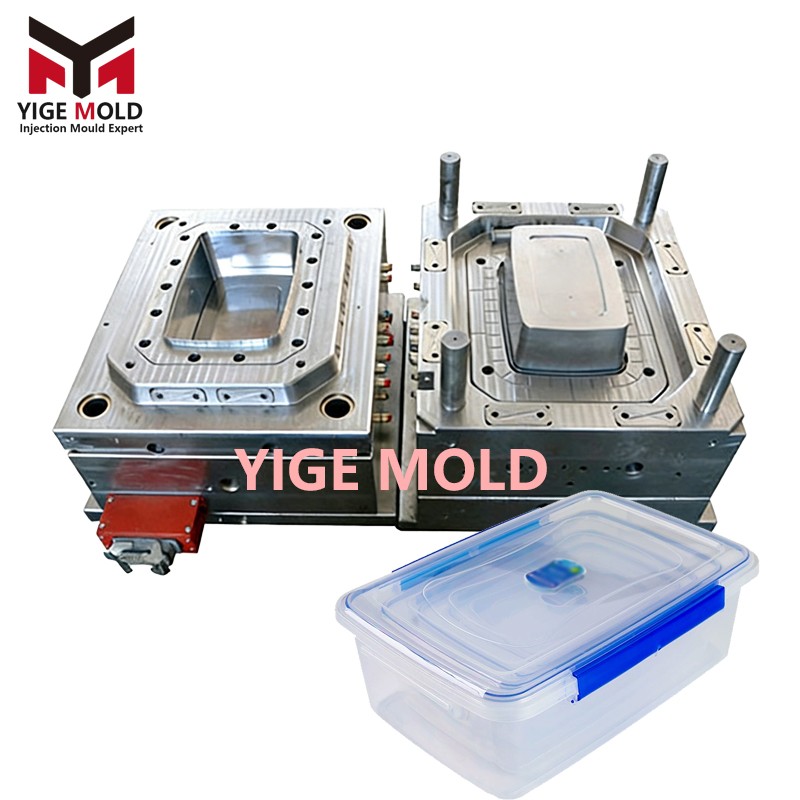
Injection Mold for Lunch Boxes: The Precision Steel Cavity that Shapes Daily Life
Within the modern industrial system, the injection mold for lunch boxes is a silent yet foundational cornerstone. It is not the final product, yet fundamentally determines the form, function, and quality of millions of food containers. It is a highly complex forming tool, constructed primarily from high-strength steel through precision machining. Its core mission is to solidify molten plastic under high temperature and pressure, enabling the mass production of lunch box products that are structurally complete and dimensionally precise. As the "origin of all forms" for plastic food containers, its design and manufacturing standards directly reflect the product's safety, aesthetics, and utility.
I. Core Structure: A Collaborative Assembly of Functional Steel Components
A complete injection mold for lunch boxes is a precisely defined system of components, far from a simple cavity assembly. Its core structure comprises several key, collaboratively functioning parts:
-
Molding System: The "Negative" of the Product
-
Cavity and Core: This is the heart of the mold, forming the interior and exterior shape of the lunch box. The cavity defines the external contours and surface texture, while the core shapes the internal space. For compartmentalized bento boxes, the core consists of multiple inserts or sliders to create complex internal dividers. The fit precision between the two determines the uniformity of the lunch box wall thickness.
-
Surface Treatment: The treatment of the cavity surface is an expression of craftsmanship. High polishing yields a mirror-like gloss; chemical etching or laser engraving can create textures like matte, leather grain, or geometric patterns. This serves not only aesthetic needs but also aids in demolding and hiding usage scratches.
-
-
Gating System: The "Waterway" for Molten Plastic
-
Sprue, Runners, and Gate: This is the channel connecting the injection molding machine nozzle to the cavity. Molten plastic is injected through it. The gate is the final entry point into the cavity. Its location and type (e.g., pinpoint gate, submarine gate) are critical, directly affecting melt flow, product appearance (gate vestige size), and subsequent finishing steps.
-
-
Ejection System: The Product's "Ejector"
-
Ejector Pins, Ejector Plate, and Return Springs: Once the plastic has cooled and solidified, it must be ejected from the core smoothly and without damage. A well-designed ejection mechanism (the position, number, and size of the ejector pins) is key to ensuring the lunch box does not deform or get damaged. Return springs ensure the ejection system accurately retracts before mold closing.
-
-
Temperature Control System: The "Stabilizing Valve" for Quality
-
Cooling Channels:The fundamental goal of its design is to achieve uniform and efficient heat dissipation from all parts of the mold cavity. Uneven cooling leads to inconsistent product shrinkage, internal stress, warpage, and even sink marks. A logical cooling channel layout is central to ensuring production efficiency and dimensional stability.
-
-
Structural System: The "Skeleton" for Mold Closing
-
Guiding Mechanism: Includes guide pins and bushings, ensuring precise alignment between the moving and fixed mold halves during closing, preventing flash caused by cavity misalignment.
-
Side-Action Core-Pulling Mechanism: When the lunch box design involves undercuts or snap-fit features, mechanisms like sliders and angle pins are required. These perform a lateral movement before mold opening to create clearance, allowing the product to be ejected successfully. This is essential for achieving functional complexity.
-
II. Process Essence: The Precision Transformation from Steel to Container
The mold is the physical vessel for the injection molding process; its design and manufacture are wholly dedicated to serving process requirements:
-
Pressure Bearing: The mold must maintain its structural integrity under the hundreds of tons of clamping force applied by the injection molding machine, without deforming or causing flash.
-
Heat Exchange Medium: The mold repeatedly endures thermal shock between molten plastic injection exceeding 200°C and cooling water circulation at around 20-80°C. The thermal conductivity and stability of its steel determine the production cycle and product quality.
-
Precision Guarantee: The leak-proof performance of a lunch box relies on the micron-level fit precision between the lid and base snaps or sealing gasket grooves. This is entirely dependent on the machining precision and wear resistance of the corresponding mold components.
-
Demolding Considerations: Mold design must incorporate an appropriate "draft angle"—a slight taper on the cavity walls—to ensure the solidified product can be smoothly ejected without being scratched or dragged.
III. The Pure Art of Design and Manufacture
The creation of a lunch box mold is the crystallization of pure mechanical design intelligence and machining artistry.
-
Iterative Design Based on Experience and Physics: Designers must comprehensively consider factors such as plastic shrinkage rate, flow characteristics, product structural strength, and wall thickness distribution to predict and avoid potential defects. The selection of the parting line, gate positioning, and cooling channel arrangement all rely on profound knowledge of materials science and process experience.
-
The Pinnacle of Precision Machining: Mold manufacturing involves a series of precision techniques: turning, milling, grinding, drilling, Electrical Discharge Machining (EDM), wire cutting, etc. The complex curves of the cavity, minute textures, and precise fitting clearances are all achieved by skilled technicians operating high-precision machine tools. A high-quality mold is, in itself, a piece of precision metal artwork.
IV. Classification Mirroring Function: The Mold as Product Blueprint
Different types of lunch boxes have distinctly different focal points in mold design:
-
Compartmentalized Bento Box Mold: The core lies in the collaborative and separate design of multiple cores, as well as balanced filling and cooling for each small compartment, ensuring precise dimensions and smooth demolding for every section.
-
Airtight Food Storage Container Mold: The focus is on the absolute precision of the sealing gasket groove dimensions on the base and lid, and the durability design of the snap-fit mechanism.
-
Microwave-Safe Lunch Box Mold: Must use steel and sealing materials that can withstand thermal cycling. The structure must avoid stress concentration points to prevent deformation during heating.
Conclusion
The injection mold for lunch boxes is a core hub in industrial civilization that solidifies abstract requirements and replicates design concepts. It involves no code or algorithms. With its steel body, rigorous physical structure, and precise mechanical coordination, it silently governs the transformation from a pellet of plastic resin into a safe, aesthetic, and practical lunch box. It is the prerequisite for all mass production. Its intrinsic qualities—precision, durability, and balance—are ultimately embedded in the lunch boxes we use daily, shaping the most fundamental and reliable texture of modern life.