Pallet and Collapsible Crate Mold Set
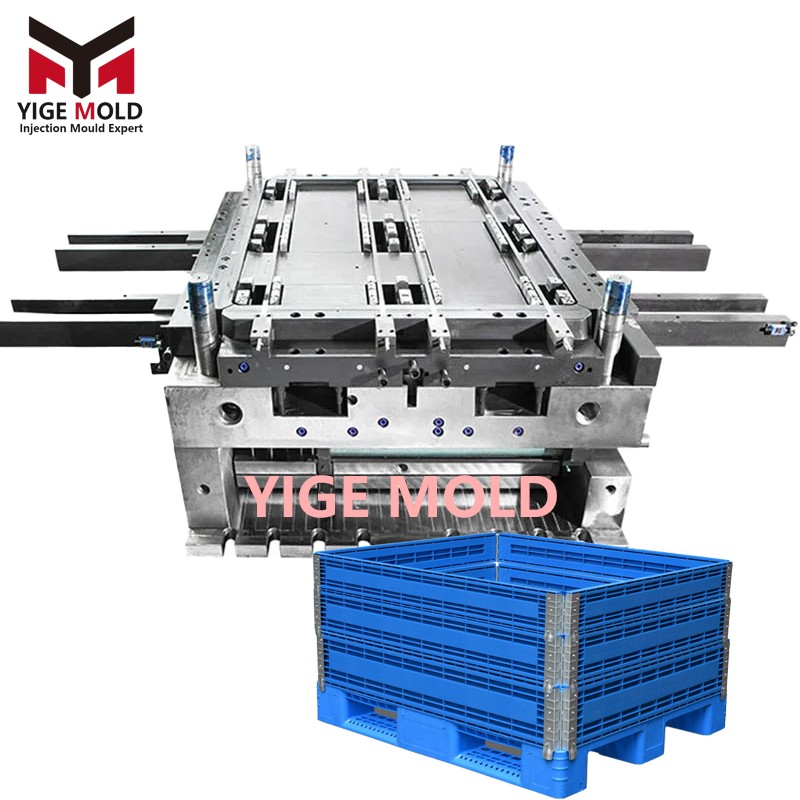
 Pallet and Collapsible Crate Mold Set: An In-Depth Analysis of Design, Advantages, and Market Applications
In modern logistics, warehousing, and manufacturing, plastic crates (also known as storage and handling containers) have become indispensable unit load carriers due to their durability, light weight, stackability, and hygienic properties. Among these, the system comprising a separate pallet and a collapsible crate—a classic and highly flexible design—relies on its core manufacturing tool: the Pallet and Collapsible Crate Mold Set. This mold set embodies sophisticated design principles and broad market adaptability. This article delves into the definition, technical characteristics, key design and manufacturing considerations, advantages and limitations compared to integral one-piece molds, and specific market application scenarios for this type of mold set.
I. Core Definition: What is a Pallet and Collapsible Crate Mold Set?
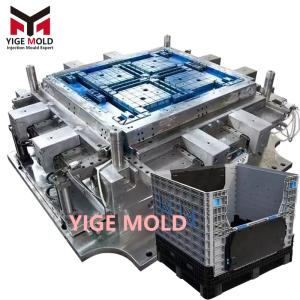
A Pallet and Collapsible Crate Mold Set does not refer to a single mold, but rather to a set (typically two sets) of injection molds used to independently produce the two main components: the "Collapsible Crate/Box" and the "Pallet/Tray."
-
Collapsible Crate/Box: Usually a four- or six-sided box designed to fold and hold goods. Its mold design involves complex hinges, latches, stacking ribs, labeling areas, etc.
-
Pallet/Tray: An independent, standardized plastic pallet designed for forklift or pallet jack handling, featuring necessary reinforcement ribs, anti-slip surfaces, and potentially a four-way entry design.
The core of this system lies in component independence. Users can freely mix, match, and replace different crates with different pallets as needed, or even use the pallet or crate separately, achieving functional modularity.
II. Technical Characteristics and Key Design/Manufacturing Considerations
The design of a Pallet and Collapsible Crate Mold Set possesses distinct features due to the modular nature of the final product.
1. Key Design Points for the Collapsible Crate Mold:
-
Structure Type: The mold for the collapsible crate is central to this set. Its design is extremely complex, requiring precise hot runner systems, sequential valve gate control (to manage the folding sequence of hinges), and high-wear-resistant steel (e.g., high-hardness stainless steel) for hinge cores to ensure hundreds of thousands of folding cycles without failure.
-
Ejection System: The crate often features complex ribs and latches, demanding high-precision design of ejection mechanisms like lifters and sliders to ensure smooth demolding and avoid warping or damage.
-
Cooling System: The crate has a large projected area with relatively thin walls, necessitating efficient and balanced cooling channel design to shorten cycle times and prevent warpage.
-
Surface Finish: The interior and exterior surfaces may require different textures (e.g., anti-slip grids, smooth finishes), requiring corresponding areas of the mold to undergo different texturing (etching) or polishing treatments.
2. Key Design Points for the Pallet Mold:
-
Balance of Strength and Weight: The pallet bears the direct load. The core of its mold design is the rib layout. Through dense, scientifically arranged rib networks, the mold aims to maximize load capacity (dynamic, static, racking) while minimizing material usage. This relies heavily on structural mechanics analysis and CAE (Computer-Aided Engineering) simulation.
-
Gating and Venting: The pallet has a large planar area, requiring multi-point balanced gating (e.g., multi-point hot runner valve gates) to ensure consistent melt flow fronts and avoid weld lines in high-stress areas. Simultaneously, sufficient venting must be designed in deep rib areas to prevent gas traps and burning.
-
Ejection System: The pallet bottom has numerous ribs and a large ejection area, requiring a high number of evenly distributed ejector pins or air-assisted ejection to prevent deformation during part ejection.
-
Standardized Interface: The top surface of the pallet must be designed with anti-slip features, positioning slots, or locking mechanisms that perfectly match the crate bottom. These require high-precision machining in the mold.
3. Mold Materials and Manufacturing Processes:
-
Key components such as cavities, cores, sliders, and hinge inserts require high-quality mold steels with high hardness, wear resistance, and polishability (e.g., P20 pre-hardened steel, H13 hot-work steel, S136 stainless steel).
-
High-precision CNC (Computer Numerical Control) machining and EDM (Electrical Discharge Machining) are employed to ensure dimensional tolerances and fit accuracy. Tolerances for mating surfaces between the pallet and crate are particularly strict.
-
To improve efficiency, the crate and pallet molds in the set are often run in parallel on large injection molding machines.
III. Core Advantages Compared to Integral (One-Piece) Pallet Box Molds
The advantages of the system produced by the Pallet and Collapsible Crate Mold Set fundamentally determine its viability in the market.
-
Unparalleled Flexibility: This is the most significant advantage. Users can "build" their system flexibly, swapping crates of different volumes based on cargo size or pallets of different specifications based on load requirements. One pallet can pair with multiple crates, greatly improving equipment utilization and scenario adaptability.
-
Excellent Maintainability and Cost-Effectiveness: If either the crate or pallet is damaged, only the damaged component needs replacement, avoiding discarding the entire unit. This lowers repair costs and aligns with circular economy principles. The molds themselves are also maintained independently, reducing the complexity and risk associated with maintaining a single, massive mold.
-
Optimized Logistics and Storage Efficiency:
-
Empty State: The collapsible crates can significantly reduce volume (often by over 60%). Separated from the pallets and nested, they drastically save space in reverse logistics and storage.
-
Mold Transportation: Two separate molds are easier to transport and handle than one oversized integral mold.
-
-
Production and Manufacturing Flexibility:
-
Different tonnage injection molding machines can be used to produce crates and pallets separately, optimizing production capacity.
-
Investment in the mold set can be staged—producing the pallet mold or crate mold first—reducing upfront capital expenditure.
-
Modifications or upgrades to a single component's mold are easier and do not affect the entire system.
-
-
Adaptability to Non-Standard & Customization: It is easier to accommodate customer-specific requests for crate interior dividers, colors, branding, or pallet structures (e.g., nine-leg, stringer, block-style), often requiring modifications to only the relevant mold in the set.
IV. Potential Limitations
-
Overall Structural Strength: Under extreme heavy loads or uneven impact, the assembly's structural strength may theoretically be slightly inferior to the seamless connection of an integral one-piece design.
-
Component Loss Risk: Separate components can be lost or mismatched due to poor management.
-
Initial Procurement Complexity: Customers need to procure crates and pallets separately, making supply chain management somewhat more complex.
V. Primary Market Application Scenarios
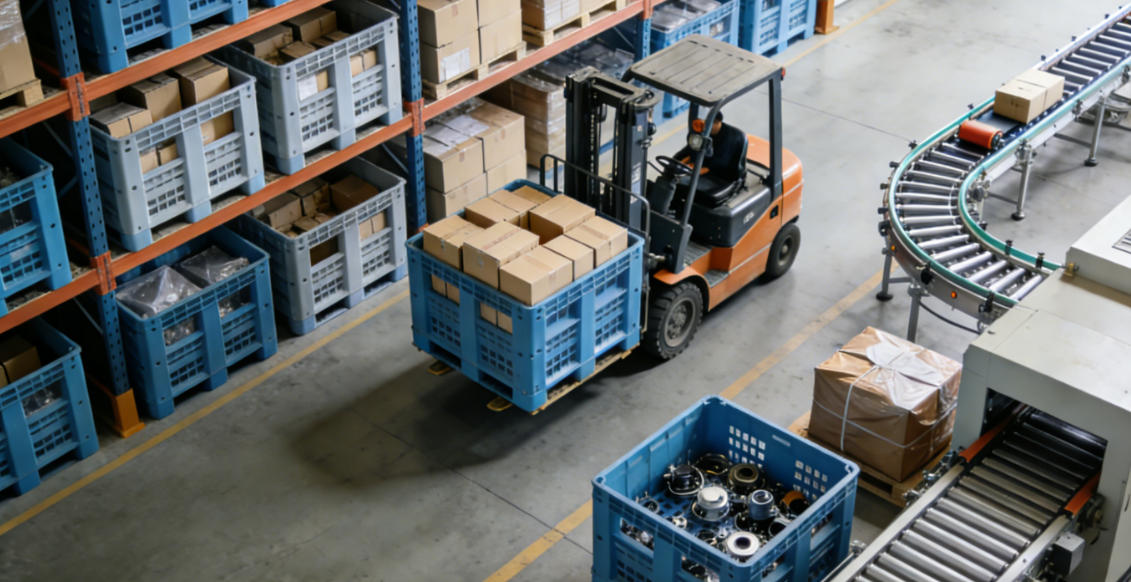
The design of the pallet and collapsible crate system produced by this mold set perfectly meets the core needs of the following sectors:
-
Automotive Manufacturing: Used for sequenced parts supply (SPS). Different workstations require crates of varying sizes for different parts, but can use standard pallets for automated handling along the assembly line.
-
Fresh Food Cold Chain & Agricultural Processing: Crates are used for washing, sorting, and cold storage, while pallets are for forklift handling. The separable design facilitates thorough cleaning, drainage, and separate sanitation.
-
E-commerce & Parcel Distribution Centers: Collapsible crates save immense space when empty and returned; standard pallets facilitate uniform handling and conveyance on automated sorting lines.
-
Flexible Manufacturing & Third-Party Logistics (3PL): Faced with diverse product categories and sizes, this separable system offers the most economical standardized handling solution.
-
Retail & Warehouse Distribution: As returnable transit packaging (RTP), it offers flexibility in handling different products during distribution from centers to stores.
The Pallet and Collapsible Crate Mold Set represents not merely production tools, but the engineering realization of a modular, sustainable, and highly flexible logistics solution. Its design is more complex and challenging, yet the product system it produces, with its unparalleled adaptability, cost-effectiveness, and maintainability, holds a central position in numerous industrial fields. For mold manufacturers, a deep understanding of downstream logistics scenarios is key to designing successful mold sets. For end-users, choosing products manufactured with such mold sets means investing in an efficient, resilient, and future-oriented material handling system.