Multi-cavity Hanger Mold

Technical Analysis and Application of Multi-Cavity Hanger Molds
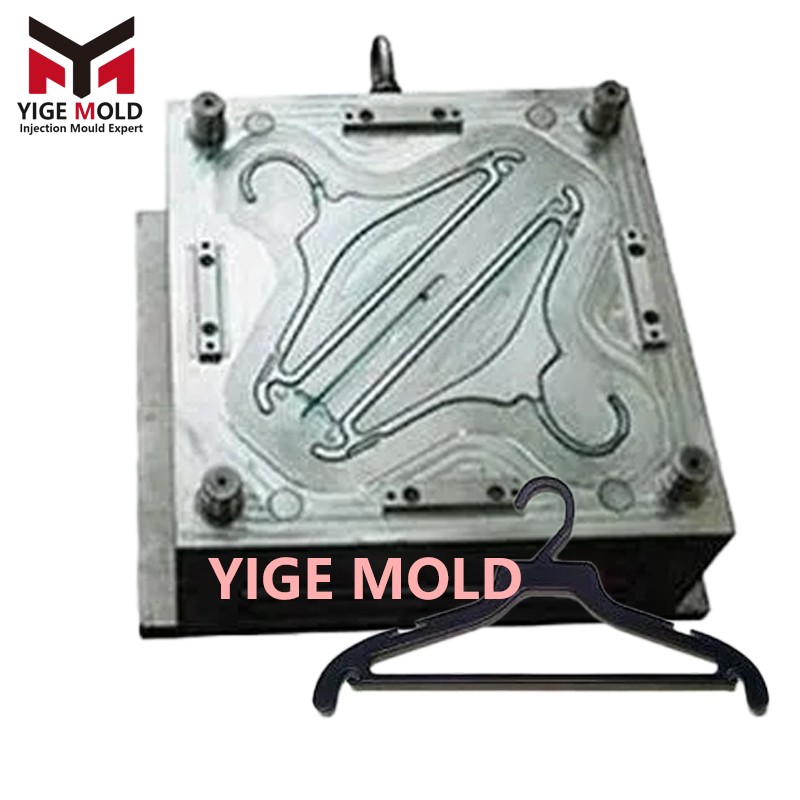
In the modern plastic products industry, hangers are consumer goods with high-frequency usage, and their production efficiency and cost control remain core issues in the manufacturing process. As a key process equipment for achieving mass production, the multi-cavity hanger mold significantly increases output per injection cycle through its design concept of integrating multiple cavities within a single mold. It has become the mainstream solution for balancing capacity requirements and economic viability. This article systematically elaborates on the technical characteristics of traditional multi-cavity hanger molds from the perspectives of structural design, material selection, molding processes, and maintenance management.
I. Structural Design: Balanced Layout and Precision Control
The core design challenge of multi-cavity hanger molds lies in the balance of the runner system and the consistency of the cavities. Since hanger products typically feature elongated rod-like structures (such as hooks, crossbars, and side arms) and must withstand certain hanging weights, mold design must ensure uniformity in wall thickness, density, and mechanical properties across all cavities.
Common layout methods employ a symmetrical runner design, using H-type or X-type runners to evenly distribute molten plastic to each cavity, preventing short shots or internal stress concentration caused by differences in flow paths. Regarding parting line design, a reasonable mold opening direction must be selected based on the structural features of the hanger (e.g., hook curvature, shoulder inclination). A double-parting-plate structure is often used to facilitate automatic degating of pin-point gates or side core-pulling demolding. For hangers with anti-slip textures or hollow-out structures, the mold must integrate slider mechanisms or angled lifter devices. This imposes higher requirements on the spatial layout of multi-cavity molds—coordinating the movement trajectories of multiple lateral core-pulling mechanisms within the limited platen size to prevent interference and collision.
Furthermore, the venting system design directly affects product surface quality. Due to the long filling paths in multi-cavity molds, trapped gas can easily lead to burn marks or incomplete filling if venting is poor. Typically, vent grooves with a depth of 0.02-0.05mm are machined at the end of the cavity and melt confluence areas, supplemented by sintered metal porous steel inserts, to ensure smooth gas expulsion.
II. Material Selection: Balancing Wear Resistance and Thermal Conductivity
The selection of mold materials requires comprehensive consideration of production volume, raw material characteristics, and cost factors. For ordinary household hangers (e.g., PP, PE materials), the cavity and core typically utilize pre-hardened plastic mold steels (such as P20, 718 series). With a hardness of 30-36 HRC, they offer good machinability and wear resistance, making them suitable for production volumes under one million cycles. For high-precision hangers or those made from glass-fiber-reinforced materials (e.g., ABS+GF), high-hardness mirror-finish mold steels (such as NAK80, S136 series) are required. Quenching treatments increase hardness to 45-52 HRC to resist melt erosion and ensure surface finish.
For the runner system, thermal conductivity is a critical concern. While traditional cold-runner molds often use the same steel as the cavity, some designs embed beryllium copper alloy inserts near the runners. Utilizing their excellent thermal conductivity accelerates heat dissipation and reduces cooling time. For molds in long-term continuous production, guide pillars and bushings should be made of high-carbon chromium bearing steel (e.g., GCr15). Carburizing and quenching treatments bring surface hardness above 60 HRC, ensuring long-term precision during mold opening and closing.
III. Molding Process: Parameter Optimization and Defect Control
Injection molding with multi-cavity molds requires strict control of process parameters to minimize variations between cavities. During the filling stage, the matching of injection speed and holding pressure is crucial. Excessive injection speed may cause jetting or air trapping, while low speed often leads to short shots. A segmented injection strategy is typically adopted: higher speeds are used when the melt flows through the sprue and runners, switching to low speed and pressure upon entering the cavities to avoid flash.
Temperature control is key to ensuring dimensional stability. The design of mold cooling channels must follow the principle of "proximity to the cavity and equal distance." Conformal cooling or baffle-type water channels are used to ensure consistent cooling rates across all cavities. For thin-walled hangers (wall thickness 1.5-2.5mm), the mold temperature is usually controlled between 40-60°C; for thick-walled or crystalline plastics (e.g., PP), it needs to be raised to 70-90°C to promote uniform crystallization and reduce shrinkage deformation.
Common molding defects and countermeasures include:
-
Flash: Mostly caused by insufficient clamping force or wear on the parting surface. Solutions include increasing clamping force, grinding the parting surface, or reducing injection pressure.
-
Sink Marks: Often appearing in thick-walled areas like the center of the crossbar. Optimization of holding time and pressure is required, or local cooling channels should be added to the corresponding mold locations.
-
Warping Deformation: Mainly caused by uneven cooling or molecular orientation differences. This can be improved by adjusting cooling time, optimizing ejection balance (e.g., increasing ejector pin count), or applying annealing treatment.
IV. Maintenance Management: Key Measures for Extending Service Life
The precision structure of multi-cavity molds dictates that maintenance must be systematic and standardized. During daily production, residual plastic and release agent carbon deposits should be cleaned from the cavity after each cycle, with a focus on checking the lubrication of moving parts such as slider guides and angled lifters, and regularly applying high-temperature grease. Every 50,000 to 100,000 cycles, the mold should undergo a comprehensive disassembly for maintenance: inspecting cavity dimensional wear (allowable tolerance is usually ≤0.02mm), polishing runner surfaces to reduce flow resistance, and replacing aging seals and springs.
Special attention must be paid to anti-rust treatment during storage. When idle, the mold should be coated with anti-rust oil, the cavity surface covered with anti-rust paper, and stored in a dry environment with humidity ≤60%. For long-term unused molds, it is recommended to power on and heat them to 50-60°C monthly to expel internal moisture and prevent moisture damage to electronic components (such as hot runner temperature controllers).
V. Application Scenarios and Economic Analysis
Multi-cavity hanger molds are widely used in daily necessities, hotel supplies, and apparel retail. Taking an 8-cavity mold as an example, compared to a single-cavity mold, its production efficiency increases by approximately 6-7 times (accounting for changeover and debugging time loss), and unit product energy consumption decreases by 30%-40%. In the cost structure, the initial mold investment accounts for about 15%-20% of the total product cost, but this incremental investment can be recovered within 3-6 months through scaled production. It is worth noting that more cavities do not always mean better performance: molds exceeding 16 cavities significantly increase the complexity of the hot runner system and platen size, leading to higher machine tonnage requirements (e.g., injection machines over 1000 tons), which may offset the efficiency advantages.
With the diversification of consumer demands for hanger functions (e.g., non-slip, foldable, multi-layer hanging), multi-cavity molds are gradually evolving towards integrated composite structures, such as forming the hanger body and detachable accessories simultaneously in a single mold to further enhance production added value. However, within the traditional manufacturing framework, multi-cavity molds will continue to dominate the mid-to-low-end hanger market due to their high stability and low-cost advantages.
In summary, the technical value of multi-cavity hanger molds is reflected in the precise balance of the "efficiency-quality-cost" triangle. Their design and manufacture require the integration of multidisciplinary knowledge, including materials science, fluid mechanics, and precision machining. Continuously optimizing molding processes and maintenance systems remains the fundamental guarantee for maximizing their performance.