PP Plastic Chair Mold
PP Plastic Chair Mold: An In-Depth Introduction
I. Strategic Position: The Economic Engine and Quality Keystone of Mass Production
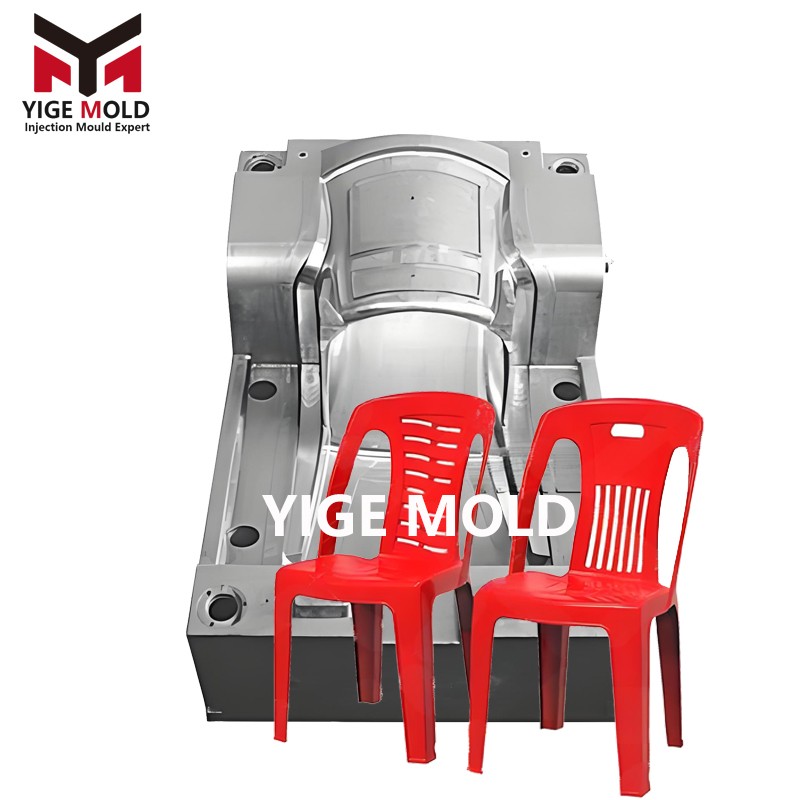
The PP (Polypropylene) Plastic Chair Mold is a specialized type of injection mold designed for the high-volume manufacturing of polypropylene chairs. Its significance extends far beyond being a mere "tool for making chairs"; it is the pivotal enabler of the plastic chair's ubiquitous presence in our daily lives, from domestic settings to public spaces. Its strategic importance is multifaceted:
-
Core Driver of Economies of Scale: The entire business model of affordable plastic chairs is predicated on mass production. A single, high-performance mold with a long service life can produce hundreds of thousands to millions of units. This immense output dramatically amortizes the initial mold investment, driving the per-unit cost down to a level that enables global accessibility and market competitiveness.
-
The Ultimate Challenge of "Thin-Walling" and Lightweighting: To minimize material usage, weight, and logistics costs, modern PP chairs are almost universally designed with thin walls (typically 2.0-3.5mm). This presents the fundamental engineering challenge for the mold: how to completely and uniformly fill a vast, complex cavity with a large projected area, using a fast-flowing yet fast-cooling material, while ensuring the final part has sufficient structural integrity and resists warpage. Solving this challenge is the essence of PP chair mold design.
-
The Bridge from "Function" to "Experience": The mold is the ultimate arbiter of quality. It determines not just whether a chair will break or warp, but also the finer points of user experience. The ergonomic contour of the seat and backrest, the stability of the legs, the precision of part assembly (e.g., stackable chairs), and the tactile feel of the surface are all "encoded" into the design and finish of the mold. A superior mold transforms a commodity item into a reliable, comfortable product.
II. Deep Coupling: PP Material Properties and Mold Design
Understanding the PP chair mold requires a deep dive into the characteristics of its processing material—Polypropylene. These properties are the primary constraints and guides for mold engineering.
-
Excellent Fluidity vs. High Shrinkage: PP's high melt flow index is a double-edged sword. It facilitates the filling of large, thin-walled sections but is coupled with high, anisotropic (direction-dependent) shrinkage (typically 1.6%-2.2%) due to its crystalline nature. Mold design must counteract this through precise shrinkage compensation calculations, scientifically optimized cooling channel layout, and strategic gate placement to control final dimensions and prevent warping—the most common and critical defect in PP chair production.
-
Good Toughness vs. Low-Temperature Brittleness: While PP offers good impact resistance and fatigue endurance for long-term use, it can be brittle at low temperatures or with sharp notches. Therefore, mold design mandates generous radii (R-fillets) at all corners, ribs, and junctions to prevent stress concentration and cracking. The ejection system must be meticulously designed to apply balanced force without causing "ejector pin push" marks or cracks.
-
Cost Sensitivity and Sustainability Pressures: PP is a cost-effective commodity plastic, but its price volatility incentivizes extreme efficiency. Mold design must achieve structural strength through intelligent rib and contour design ("doing more with less") to minimize material use. Furthermore, to accommodate recycled PP (rPP) or bio-based PP, molds may require enhanced corrosion resistance (as additives/degradants can release corrosive gases) and broader processing windows.
III. Core Systems and Critical Technical Features
A state-of-the-art PP chair mold is a synergistic integration of several sophisticated systems:
-
The Gating System: The Art of Flow
-
The Hot Runner System is virtually standard. Given the large part size, multi-point, valve-gated hot runners are essential. They eliminate cold runner waste, maintain melt temperature, and enable sequential filling—critical for balancing fill across a large part, minimizing weld lines (which weaken thin walls), and reducing internal stresses. Gate locations are strategically chosen, often under the seat or on non-visible surfaces, to optimize flow and hide vestiges.
-
-
The Cooling System: The Gatekeeper of Efficiency and Flatness
-
Cooling dictates the cycle time. For PP chairs, uniform cooling is paramount to prevent warpage. The mold incorporates dense, conformal cooling channels surrounding the cavity and core. Advanced techniques like baffles, bubblers, or 3D-printed conformal cooling channels are used to extract heat efficiently from thick sections (like rib intersections) and ensure a consistent cooling rate across the entire part.
-
-
The Molding and Ejection System: Enabling Complexity
-
Complex Core-Pulling Mechanisms: The underside of a chair, with its intricate grid of reinforcing ribs, snap-fits, and stacking features, requires numerous slides, lifters, and angled lifters. The strength, wear resistance, and timing accuracy of these mechanisms are vital for mold longevity and reliable part release.
-
Balanced Ejection Design: The large surface area necessitates a perfectly balanced ejection strategy. A vast array of evenly distributed ejector pins, sleeves, and blade ejectors is used. In some cases, air-assisted ejection or a two-stage ejection sequence is employed to gently release the large, thin-walled part without distortion or damage.
-
-
The Venting System: Where Details Determine Success
-
Trapped air is a critical failure risk during high-speed filling of a large cavity, leading to burns, short shots, or poor surface finish. Beyond standard parting line vents, dedicated venting pins/plugs or vents are placed at last-to-fill areas and deep within rib structures to allow air escape.
-
IV. Advanced Technologies and Industry Trends
-
Front-Loaded CAE Simulation: Moldflow or similar CAE software is indispensable. It simulates fill, pack, cool, and warp cycles during the design phase, allowing engineers to optimize gate design, predict and eliminate weld lines/air traps, and foresee warpage issues. This "simulate first, build later" approach drastically reduces costly trial-and-error adjustments.
-
High-Longevity & Corrosion-Resistant Materials: Cavity and core inserts are made from high-hardness, high-polishability mold steels like P20, 718H, or S136 stainless. For molds running highly abrasive recycled content or corrosive additives, specialized surface treatments (hard chrome plating, PVD coatings) or stainless steels are increasingly used.
-
High-Efficiency Mold Configurations: To maximize output, multi-cavity molds (e.g., 2+ chairs per cycle) are common. The more advanced stack mold technology doubles output per cycle by molding parts on two levels simultaneously, though it demands exceptional mold balance and clamping control.
-
Functional Integration: Molds are evolving to add value. Special texture etching (e.g., wood grain, linen) creates aesthetic surfaces. Interchangeable inserts allow for producing different chair variants (with/without armrests, different logos) from the same base mold, enhancing flexibility.
V. Challenges and Future Outlook
-
Challenges: The core tension lies in the relentless pressure to reduce cost while simultaneously raising quality and sustainability standards. The demand for shorter cycles, less material, and greater durability presents a constant engineering puzzle. Global supply chain volatility further pressures mold delivery times and cost control.
-
Future Directions: The adoption of Industry 4.0 principles will see more molds embedded with sensors for real-time monitoring of temperature, pressure, and wear, enabling predictive maintenance and process optimization. Conformal cooling via 3D metal printing will become more prevalent, offering unmatched cooling efficiency for complex geometries. Furthermore, to support the circular economy, future mold designs will need superior robustness to process variable grades and blends of recycled PP, accommodating inconsistent flow and shrinkage characteristics.
Conclusion
The PP Plastic Chair Mold is the uncelebrated workhorse behind "democratic design." It is the precision instrument that transforms a low-cost polymer into an accessible, functional object of daily use for billions. Each seemingly simple chair is a testament to the reliability, efficiency, and scale enabled by a highly sophisticated and valuable mold. From the designer's sketch to the CAD model, from the roar of the injection molding machine to the final product—the PP Plastic Chair Mold stands as the critical, solid nexus in this value chain. It is a quintessential example of engineering artistry silently underpinning the material foundation of modern life, proving that advanced manufacturing and mass accessibility are not mutually exclusive but fundamentally intertwined.