Vegetable basket injection mold
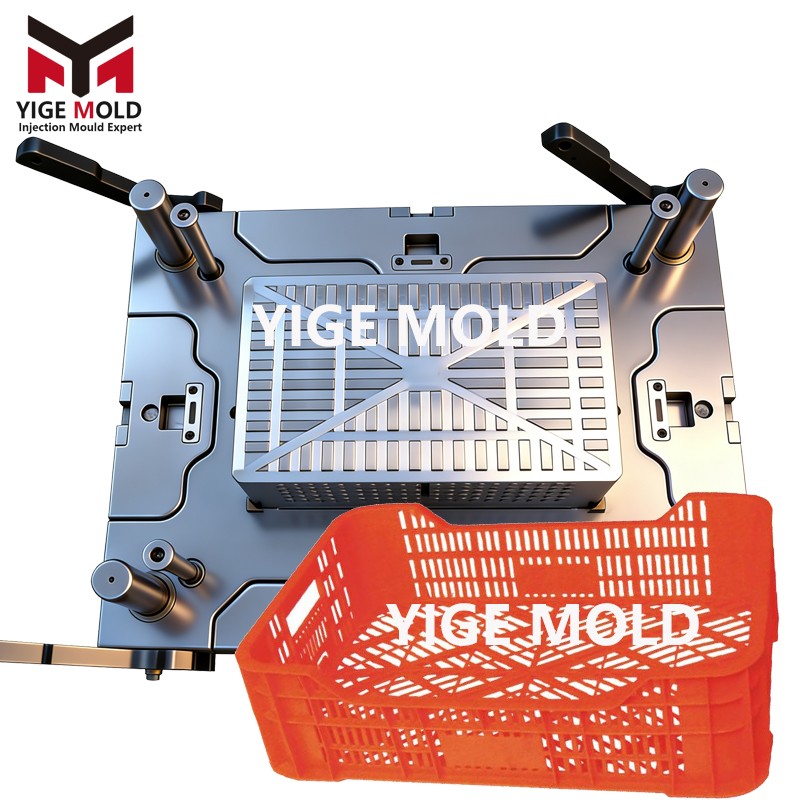
Vegetable Basket Injection Mold
Product Definition:
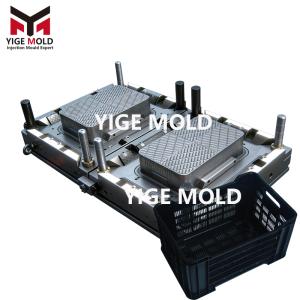
A vegetable basket injection mold is a specialized tooling system for producing household and commercial containers for storing fruits and vegetables. The final product must comply with food contact safety standards (e.g., FDA 21 CFR, EU 10/2011) and possess features such as ventilation, drainage, stackability, lightweight design, and durability. Common materials are food-grade PP (Polypropylene) or PE (Polyethylene). Typical structural features include a grid-style body, perforated handles, and anti-slip feet.
Mold Technology System:
-
Ventilation Structure Molding Technology
-
Angled Lifter / Slider Matrix System: To form the dense ventilation grids on the basket sides (typical hole diameter 8-15mm), an array of miniature angled lifters (individual size Φ3-5mm) or laterally combined slider groups is used. This ensures the simultaneous demolding of hundreds of grid holes without drag marks. The clearance between lifters must be ≤0.02mm to prevent flash.
-
Special-Shaped Ejector Pin Design: Diamond-cross-section ejector pins are used at grid intersection nodes, providing ejection force while avoiding blockage of ventilation holes.
-
-
Thin-Wall Rapid Cooling System
-
Basket wall thickness is generally 1.2-1.8mm, requiring a multi-layer series cooling circuit:
Cooling Topology: Fixed mold half: Spiral channels + Baffle-cooled wells (covering thick handle areas) Moving mold half: S-shaped serpentine channels + Cooling pins (for dense grid areas) Water temperature control: 15-25°C (low temperature for fast setting) -
High Thermal Conductivity Inserts: Beryllium copper inserts are embedded in locally thickened areas like handle roots and base support points, increasing cooling efficiency by 40%.
-
-
Runner Balancing and Venting Optimization
-
Employs a hot-to-cold runner system with pinpoint gates. 8-12 gates are evenly distributed along the upper rim of the basket. Moldflow analysis ensures synchronized flow front meeting.
-
3D Venting Network:
-
Parting line vents: Depth 0.015-0.025mm
-
Slider mating surface vents: Stepped 0.03/0.02/0.01mm three-stage structure
-
Ejector pin venting: Micro-clearance of 0.005mm on ejector pins ≥Φ2mm
-
-
Precision Manufacturing Standards:
|
Control Item |
Precision Target |
Inspection Method |
|---|---|---|
|
Cumulative Error of Grid Holes |
≤0.1mm per 100 holes |
Vision Measuring System (5μm accuracy) |
|
Handle Symmetry |
≤0.3mm (relative to basket axis) |
CMM Scanning vs. CAD Model |
|
Stacking Fit Clearance |
0.5-1.0mm (tier spacing) |
Go/No-Go Gauge Check |
|
Ejector Pin Action Sync |
Timing deviation ≤0.03 seconds |
High-Speed Camera (1000 fps) |
Molding Process Window:
-
High-Speed Thin-Wall Injection Parameters
Material: Food-grade PP (Melt Flow Rate 25-35 g/10min) Injection Speed Profile: Stage 1 (0-30%): Low Speed 15% (Gate penetration) Stage 2 (30-85%): High Speed 90% (Rapid filling) Stage 3 (85-100%): Medium Speed 40% (V/P switchover) Packing Pressure: 25-35 MPa (3-stage decreasing) Cooling Time: 8-12 seconds (for 1.5mm wall reference) -
Warpage Control Strategy
-
Mold Temperature Difference Control: ΔT between mold halves ≤5°C
-
Adaptive Packing Pressure: Real-time adjustment based on cavity pressure sensor feedback
-
Robot-Assisted Shaping: Immediate placement into cooling jigs after removal
-
Mold Lifecycle Management:
-
Key Component Wear Resistance Treatment
-
Lifter/Slider surfaces: DLC (Diamond-Like Carbon) coating (Hardness HV3000+)
-
Grid-forming cores: Powder metallurgy high-speed steel (e.g., ASP-23)
-
Hot nozzles: Bimetallic composite structure (H13 core, stainless steel shell)
-
-
Maintenance Cycle
-
Every 100k cycles: Clean lifter guide bushings, replace ejector pin springs.
-
Every 300k cycles: Polish cavity surfaces, recalibrate slider preload.
-
Every 500k cycles: Comprehensive inspection of cooling channel scaling.
-
Technology Innovation Directions:
-
Variable Ventilation Rate Mold: Quick change of grid patterns via insert swapping.
-
Multi-Material Co-injection: One-shot molding of rigid PP basket body with soft TPE handles.
-
IoT Monitoring: Real-time monitoring of shear heat in grid areas, warning of material degradation.
Market Data:
-
Annual domestic demand (China forecast 2025): ~20 million sets
-
Typical mold life: 800k - 1.2 million cycles
-
Investment payback period: 6-9 months (under two-shift production)
This type of mold has achieved a high degree of standardization. Through modular design, it can be adapted for 5L-25L capacity series. Industrial clusters have formed in regions like Taizhou (Zhejiang) and Dongguan (Guangdong). Export products comply with international standards such as EU REACH and US CPSC.