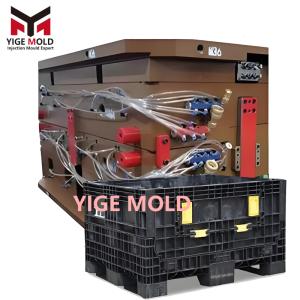
Plastic laundry hamper mold
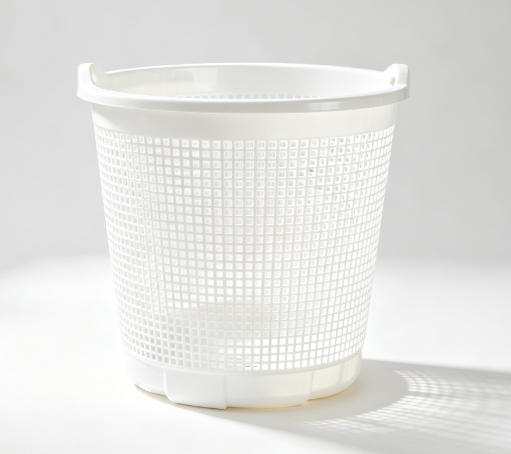
Plastic Laundry Hamper Mold: In-Depth Analysis of Precision Design and Manufacturing
I. Design Philosophy: Structural Breakthrough for Deep-Cavity Thin-Wall Molds
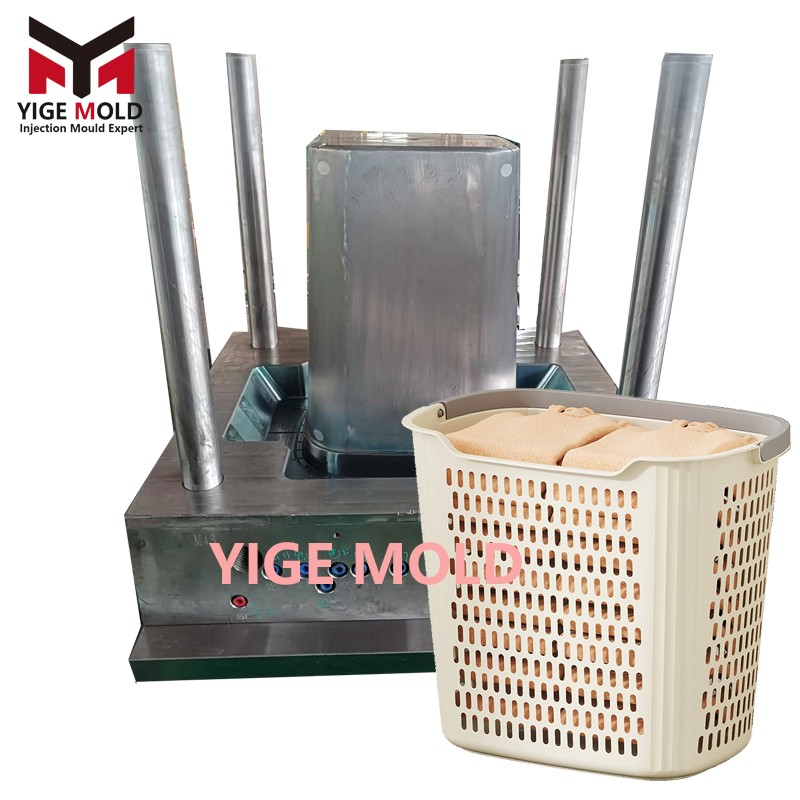
Classified within the injection mold industry as a "Deep-Cavity, Thin-Wall, and Multi-Hole" structure, the plastic laundry hamper mold’s core design challenge lies not in simple cavity carving, but in balancing injection pressure, cooling efficiency, and ejection resistance under a massive projected area.
1. Parting Line Topology Logic
Unlike flat containers, laundry hampers feature significant depth (typically 400–600 mm). Therefore, parting line design often adopts "Tangential Parting" or "Stepped Parting".
-
Avoiding Sharp Corners: During the design phase, generous radii (R-angle transitions) are applied to the basket rim to prevent stress concentration that causes flash.
-
Overflow Grooves: Primary parting surfaces incorporate overflow grooves (width 5 mm, depth 0.05 mm) to accommodate cold slug material, preventing burrs caused by insufficient clamping force.
2. Fluid Dynamics of the Gating System
Due to large volume but thin walls (typically 1.5–2.0 mm), flow resistance is extreme.
-
Direct Gate Design: As cosmetic appearance allows for gate vestiges, approximately 90% of laundry hamper molds utilize direct gates or fan gates. Gate diameters typically range from Φ4–Φ6 mm to minimize shear heat while ensuring the melt fills the farthest extremities before solidifying.
-
Runner Balancing: For multi-cavity layouts (e.g., 1x2), runners employ a "Trapezoidal plus Circular" hybrid cross-section. Moldflow analysis software precisely calculates pressure drops across branches to ensure fill time discrepancies between cavities remain below 0.1 seconds.
II. Core Mechanisms: Forming Solutions for Complex Meshes
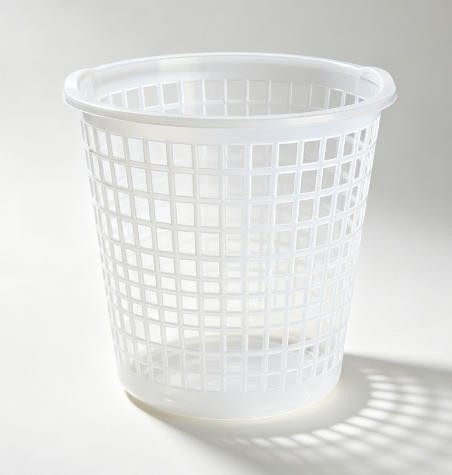
The mesh structure surrounding the hamper is the most challenging aspect of mold construction, directly determining mold lifespan and maintainability.
1. Pin Matrix Technology
To address mesh demolding, the core is not constructed from a solid steel block but utilizes an insert splicing method.
-
Material Selection: The pins forming the mesh holes utilize Beryllium Copper (BeCu) or Aluminum Alloy inserts. Leveraging BeCu’s superior thermal conductivity (approximately three times that of steel) solves the heat accumulation issue in these fine projections.
-
Fixing Methods: Techniques such as "Flat-head screws with clamping plates" or "Interference fit with thermal assembly" secure hundreds of pins to the core backing plate, ensuring no displacement occurs under high injection pressure.
2. Trade-off Between Forced Ejection and Side Actions
Some irregular hampers (e.g., oval with handles) feature undercuts.
-
Slider Mechanism: For side undercuts, cam-driven sliders are designed. Due to the large footprint, slider guides must incorporate wear plates, typically bronze-graphite alloys, to prevent galling and fatigue damage from long-term sliding contact.
III. Manufacturing Process: From Rough Machining to Precision Assembly
The creation of a high-quality laundry hamper mold relies on strict processing flows and heat treatment protocols.
1. Pre-treatment of Mold Base and Core Materials
-
Mold Base Body: Constructed from S50C (JIS) or 1050 medium-carbon steel. After forging, spheroidizing annealing achieves a hardness of HB 180–220 to ensure machinability.
-
Cavity Inserts: Made from 718H (Swedish Steel) or P20+Ni. These pre-hardened steels arrive with a hardness of HRC 30–34, eliminating the need for post-machining quenching and avoiding dimensional deviations caused by heat treatment distortion.
2. CNC Machining Strategy: Layered Cutting
Addressing the deep-cavity nature, CNC programming employs a hybrid of "Constant Z Contour + Planar Milling."
-
Roughing: Leaves a 0.5–0.8 mm allowance, utilizing high-feed, low-RPM strategies to remove bulk waste.
-
Semi-finishing: Leaves a 0.1–0.15 mm allowance, focusing on maintaining sidewall perpendicularity.
-
Finishing: Uses ball-nose or corner-radius end mills to scan along surface UV lines, achieving a surface roughness of Ra ≤ 0.8 μm to meet subsequent texturing requirements.
3. Application of EDM and WEDM
-
Corner Clearing: For narrow gaps between mesh inserts (typically only 0.8–1.2 mm wide), CNC tools cannot reach. Precision EDM (Electrical Discharge Machining) is mandatory to ensure sharp corners without collapse.
-
Insert Slicing: All mesh inserts undergo Slow-Speed Wire EDM (WEDM-LS) cutting. Verticality must be controlled within 0.005 mm/m to ensure uniform assembly gaps.
IV. Thermal Control System: Engineering Practice of Conformal Cooling
Cooling efficiency dictates production capacity. Due to uneven wall thickness, traditional straight-through waterlines are inadequate.
1. Baffle Technology
Inside slender handle-like structures or columns, deep holes are drilled to install "Bullet-shaped Baffles." This forces water to jet from the core tip to the bottom and back (fountain effect), increasing heat exchange efficiency by 40% compared to straight pipes.
2. Spiral Waterline Design
For thick-walled bottom sections, Double-start Spiral Grooves are machined. Coolant flows in a helical path, extending heat exchange time to ensure shrinkage in the base matches the sidewalls, preventing warpage due to uneven cooling.
V. Surface Treatment and Quality Control
1. Texturing and Sandblasting
High-gloss finishes are unnecessary. To conceal weld lines and improve grip, cavity surfaces often receive Sandblasting (e.g., #240–#320 grit) or Chemical Etching (EDM Texturing). This enhances aesthetics and aids micro-venting during injection.
2. Trial Shots and Correction
The final stage is trial molding verification.
-
First Article Inspection: Critical dimensions, especially rim diameter and stacking tolerance, are checked using a Coordinate Measuring Machine (CMM) with tolerances controlled within ±0.2 mm.
-
Flash Correction: If flash appears at the parting line, grinding is prohibited. Instead, the "Weld Repair + Re-fitting" process ensures the mold datum remains unchanged.
Conclusion
The design and manufacturing of plastic laundry hamper molds represent a sophisticated game of space, material science, and thermodynamics. From a multi-ton steel billet to a mold comprising thousands of precision components—every drill angle, pin fit, and waterline path embodies the mold maker's challenge to physical limits. It produces not just a container for clothes, but a showcase of ultimate industrial craftsmanship in simplifying complexity.