Plastic Grating Mold
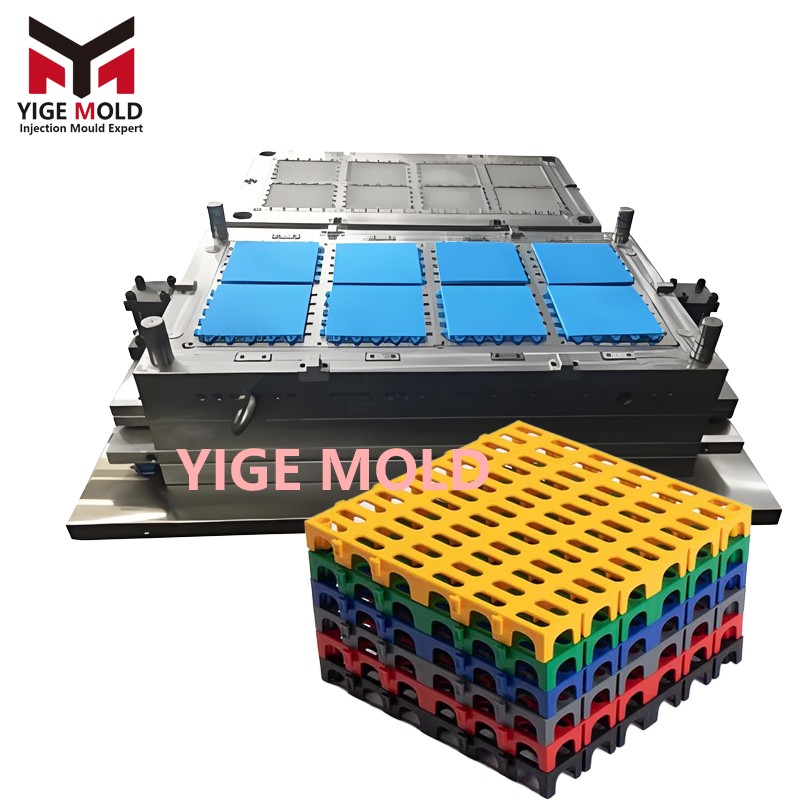
 Plastic Grating Mold: The Giver of Form to Load-Bearing Structures
Opening: The Transfer of Force Through Bar Structures
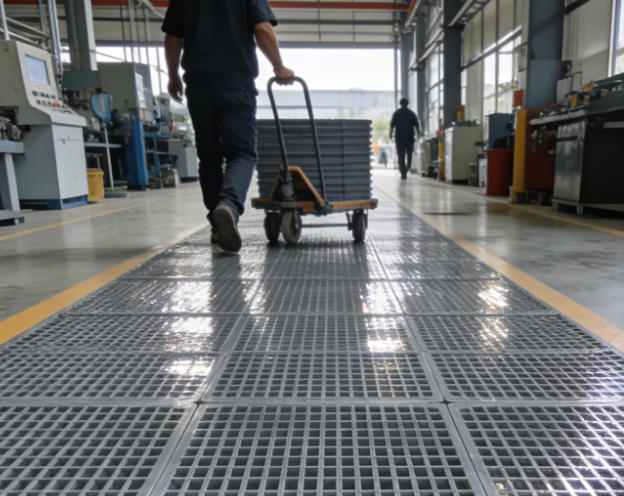
In modern drainage systems, industrial platforms, and walkway surfaces, plastic gratings bear weight, channel water flow, and ensure safety with their unique bar structures. The plastic grating mold, as the key production tool for shaping this load-bearing structure, must not only accurately reproduce the geometric form of parallel or intersecting bars but also ensure structural stability under long-term load, fatigue resistance, and dimensional accuracy. This mold system is the product of the integration of statics, materials science, and precision manufacturing technology.
I. Design Principles for Load-Bearing Structures
1. Mechanical Configuration of the Bar System
Grating mold design begins with a deep understanding of load-bearing structures:
Primary-Secondary Bar System: Load-bearing gratings use a composite structure of primary and secondary bars. Primary bars bear the main load, with an inverted T-shaped cross-section: top width 12-15 mm, bottom width 8-10 mm, height 25-30 mm. Secondary bars provide connection and stability, with an I-shaped cross-section: flange width 6-8 mm, web thickness 3-4 mm, height 20-25 mm. The spacing ratio between primary and secondary bars is typically 3:2, ensuring uniform load transfer.
Reinforcement Design for Connection Nodes: Intersection nodes are structural weak points requiring special reinforcement. Wall thickness in node areas is increased by 40-50%, with internal cross-shaped reinforcing ribs, rib height 1/3 of the bar height. A ring-shaped reinforcing band surrounds the node, 5-6 mm wide, band thickness 20% greater than the bar wall thickness. The node bottom forms a reinforcing column, diameter Φ8-10 mm, height 8-10 mm, integrated with the base plate.
Construction of Anti-Slip Surfaces: Walkway gratings require anti-slip design. The mold forms anti-slip teeth on bar tops: tooth height 1.2-1.5 mm, tooth pitch 4-5 mm, tooth shape a 60-degree isosceles triangle. Tooth tips are rounded to R0.3 mm, ensuring anti-slip effect while avoiding sole damage. Anti-slip teeth are continuously arranged along the bar length, with teeth on adjacent bars offset by 1/2 pitch.
2. Systematic Assurance of Structural Stability
Long-term load-bearing requires deformation control from the design source:
Pre-Camber Design: Accounting for deflection during use, the mold has a preset reverse camber. A 1-meter span grating has 2-3 mm pre-camber, a 2-meter span has 4-6 mm, distributed along the length according to a quadratic curve. The camber peak is at the span midpoint, transitioning smoothly to the ends. Camber is achieved by adjusting cavity curvature, curvature radius R=20-30 m.
Stress Concentration Control: Special treatment in stress concentration areas. Bar ends are tapered, taper length 30-40 mm, width gradually reducing from standard to 60% at the end. Corners use large radii: internal radii R15-20 mm, external radii R25-30 mm. Abrupt section changes have a 1:8 tapered transition zone.
Thermal Deformation Compensation: Accounting for anisotropic shrinkage during plastic cooling, differential compensation is applied. Length direction: 1.8-2.0%. Width direction: 1.6-1.8%. Thickness direction: 2.0-2.2%. Bar spacing compensation is 0.1-0.2% greater than bar width compensation, ensuring stable opening dimensions.
II. Load-Bearing Adaptation in Mold Construction
1. Manufacturing of High-Load Cavities
Grating molds must withstand high injection pressures:
Selection of High-Strength Steel: Cavity plates use P20+Ni pre-hardened steel, hardness HRC 32-36, yield strength ≥1000 MPa. Cores use H13 hot-work tool steel, heat-treated to HRC 48-52, good red hardness. Guide pins use GCr15 bearing steel, quenched to HRC 60-63. Plate thickness is 20-30% greater than standard molds.
Deep Slot Machining Process: Bar gap slots have a high depth-to-width ratio, making machining difficult. Layered milling is used: first, a Φ20R4 bull-nose end mill for roughing, depth of cut 2 mm, stepover 15 mm; then a Φ10R2 tool for semi-finishing, depth 1 mm, stepover 0.8 mm; finally, a Φ6R3 ball-nose cutter for finishing, depth 0.3 mm, stepover 0.2 mm. After machining, sidewall perpendicularity is ≤0.02 mm/100 mm.
Surface Hardening Treatment: Cavity surfaces receive a PVD coating, material AlCrN, thickness 3-5 µm, hardness HV2800-3200. Prior to coating, ion nitriding is applied, case depth 0.2-0.25 mm, surface hardness HV1000-1200. The combined treatment increases mold life 3-5 times.
2. Load-Bearing Optimization of Venting and Cooling
Thick-walled gratings have special requirements for venting and cooling:
High-Pressure Venting System: Gratings require high injection pressure, necessitating enhanced venting. Stepped vent slots are machined on the parting line: Level 1 depth 0.03 mm, width 8 mm; Level 2 depth 0.05 mm, width 6 mm; Level 3 depth 0.08 mm, open to atmosphere. Total vent area is 1.5-2.0% of projected area. Vent holes Φ1.0 mm are placed at bar bottoms, depth 15-20 mm.
Zoned Cooling Design: Cooling is zoned based on bar thickness. Thick bar areas (primary bars): channels 12-15 mm from surface, diameter Φ12 mm, water velocity 2.5-3.0 m/s. Thin bar areas (secondary bars): channels 8-10 mm from surface, diameter Φ10 mm, velocity 2.0-2.5 m/s. Node areas have point cooling using high-speed steel thermal pins, conductivity 80-100 W/m·K.
Precise Control of Temperature Field: The mold uses zoned temperature control: primary bar area 60-65°C, secondary bar area 55-60°C, node area 50-55°C. Cooling water uses constant temperature control, inlet temperature 20-25°C, ΔT ≤2°C. Multi-point temperature measurement allows real-time adjustment for uniform temperature.
III. High-Load Design of Demolding Mechanisms
1. Demolding of Structures with High Aspect Ratio
Grating bars are deep and narrow, creating high demolding resistance:
Multi-Stage Ejection System: A three-stage ejection mechanism is used. Stage 1: Ejection at bar bottoms, pin diameter Φ8 mm, stroke 10-15 mm, force 5-8 tons. Stage 2: Lateral auxiliary ejection, block area 30×30 mm, stroke 8-10 mm, force 3-5 tons. Stage 3: Overall ejection, plate area similar to grating, stroke 20-25 mm, force 10-15 tons. The three stages are sequentially interlocked, with 0.2-0.3 second intervals.
High-Pressure Gas-Assisted Demolding: Micro gas nozzles are placed at the bottom of deep bar cavities, orifice Φ0.6-0.8 mm, spacing 50-60 mm. During demolding, 0.6-0.8 MPa compressed air is injected for 0.4-0.6 seconds. Pressure is staged: start 0.3-0.4 MPa to break vacuum, after 0.5 seconds rise to 0.6-0.8 MPa to complete demolding. Air circuits are independently controlled, can be activated by zone.
Variable-Stiffness Ejector Pin System: Pins have a composite structure: pin body is high-strength steel, pin tip is elastic material. Tip hardness Shore A 70-75, compression 15-20%. During ejection, the tip contacts the part first, evenly distributing stress. Pin density is 4-6 pins per 100×100 mm area, arranged in a quincunx pattern.
2. High-Precision Guiding and Positioning
Large grating molds have extremely high requirements for motion precision:
Four-Corner, Eight-Surface Guiding: The mold has dual guiding at four corners. Outer layer: square guide pins, section 50×50 mm, guide length 300-400 mm. Inner layer: round guide pins, diameter Φ40 mm, guide length 200-250 mm. Guide clearance 0.008-0.012 mm, ensured by selective fitting. Guide surfaces are hard-chrome plated, thickness 0.05-0.08 mm.
Hydraulic-Assisted Positioning: A hydraulic positioning system provides 10-15 tons of force. Positioning pins diameter Φ25 mm, bushings are lined with copper alloy, fit clearance 0.005-0.008 mm. Positioning stroke has two segments: rapid approach at 50-80 mm/s, slow positioning at 5-10 mm/s. Positioning accuracy ±0.005 mm.
Deformation Compensation Mechanism: Accounting for elastic deformation of plates under high pressure, pre-deformation compensation is set. Plate center has 0.1-0.15 mm pre-camber, compensating bending during clamp. Guide pin mounting holes have 0.02-0.03 mm preset eccentricity, compensating offset under load. All compensation is adjustable for different process conditions.
IV. Heavy-Duty Control of the Production Process
1. High-Pressure Molding Process Control
Gratings require high-pressure filling:
Multi-Stage Injection Parameters: Injection is controlled in 4-5 stages. Stage 1: Low speed/low pressure to fill runners, 20-30 mm/s, 40-50 MPa. Stage 2: Medium speed/medium pressure to fill bar bottoms, 40-60 mm/s, 60-80 MPa. Stage 3: High speed/high pressure to fill bar bodies, 80-100 mm/s, 100-120 MPa. Stage 4: Reduced speed/pressure to complete fill, 30-40 mm/s, 80-100 MPa. Injection time 8-12 seconds.
Variable Packing Pressure Curve: Packing pressure decays exponentially over time. 0-3 seconds: 90-100% of injection pressure. 3-6 seconds: 80-90%. 6-10 seconds: 70-80%. After 10 seconds: maintained at 60-70%. Packing time is based on thickest section: 15-20 seconds per mm wall thickness. The switch point is determined by both screw position and pressure.
Temperature Gradient Management: A temperature gradient is established from barrel to mold. Barrel rear zone: 180-190°C. Middle zone: 200-210°C. Front zone: 220-230°C. Hot runner: 230-240°C. Mold temperature gradient: Gate area 65-70°C. Center area 60-65°C. Edge area 55-60°C. Temperature control accuracy ±1°C.
2. Ensuring Long-Term Stable Production
Ensuring mold operation under heavy load over the long term:
Periodic Accuracy Inspection: A full inspection every 5,000 cycles. A laser tracker measures mold flatness, parallelism, perpendicularity. A CMM measures key bar dimensions. Data is entered into a database, plotting accuracy change curves. Preventive maintenance is performed when accuracy degrades to 80% of tolerance.
Stress Monitoring and Relief: Stress sensors are installed at key plate locations, monitoring molding stress in real-time. A stress-life model predicts remaining mold life. Periodic stress relief treatments include cryogenic aging (-40°C × 4 hours) and vibratory stress relief (frequency 100 Hz, amplitude 0.5 mm, time 2 hours).
Systematic Maintenance System: A three-level maintenance system. Daily maintenance: Cleaning, lubrication, inspection per shift. Periodic maintenance: Bi-weekly check of hydraulic system, cleaning cooling channels, calibrating temperature system. Preventive maintenance: Quarterly check for wear, dimensional measurement, replacement of wear parts. Maintenance records are digitized for full lifecycle management.
Conclusion: The Engineering Interpretation of Bearing Beauty
The plastic grating mold, this industrial equipment that transforms bar structures into load-bearing entities, contains complex mechanical calculations within its simple lines. It not only defines the geometric dimensions of the bars but also determines the load-bearing capacity of the structure; it not only controls production precision and efficiency but also ensures safety and durability in use.
When plastic fills the cavity under high pressure and solidifies into a load-bearing grid, we witness the transformation of material from flow to solidification, and more importantly, the transfer of force from concentration to distribution. Each straight bar is the result of precise pressure control; each firm node is the endpoint of careful thermal management; each successful demolding is proof of perfect mechanical coordination.
In an era where infrastructure is increasingly important, the plastic grating mold, with its solid technical foundation, supports the smoothness of drainage systems, the stability of industrial platforms, and the safety of pedestrian walkways. In this age that requires bearing, this mold system, with its rigorous engineering logic, interprets manufacturing technology's profound understanding of structural performance, writing the unique expression of industrial civilization's appreciation for the beauty of bearing.