Tee drainage pipe fitting mould
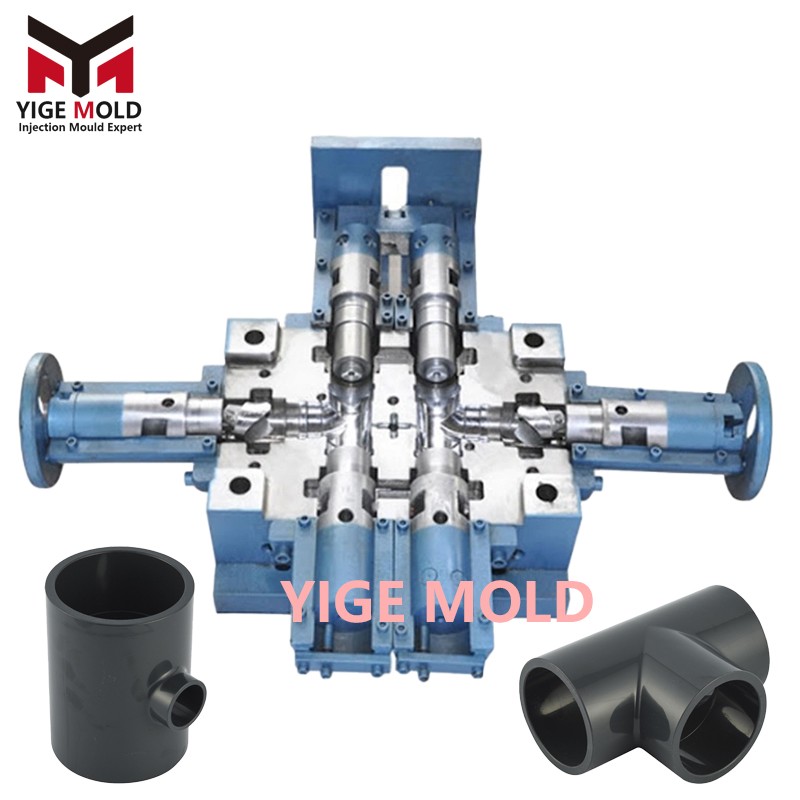
T-Type Drainage Pipe Fitting Mold: An In-Depth Analysis of Design, Manufacturing, and Process
In modern construction, municipal engineering, and industrial drainage systems, plastic piping networks function like the city's "blood vessels," while various pipe fittings are the critical "junctions" ensuring the smooth flow of "blood" (fluid). Among them, the T-type (tee) drainage pipe fitting plays the core role of flow division or convergence, connecting the main pipeline to branch lines. The T-type drainage pipe fitting mold, as the industrial mother machine for the batch, efficient, and precise manufacturing of this key component, directly determines the quality, system reliability, and production cost of the final pipe fitting through its technological content and process level. This article provides an in-depth analysis of the design essence, manufacturing key points, and application fields of this type of mold.
Part 1: Function and Requirements of T-Type Drainage Pipe Fittings
Before delving into the mold, it is essential to understand its product. T-type drainage pipe fittings are primarily used in drainage systems made of materials such as PVC-U (unplasticized polyvinyl chloride), PP (polypropylene), and HDPE (high-density polyethylene). Their core functions include:
-
Altering Flow Direction: Enabling fluid distribution or collection in three directions.
-
Connecting Branches: Tapping a branch line from the main pipeline to connect sanitary appliances, equipment, or other lines.
-
Bearing Load: Requiring sufficient structural strength to withstand internal fluid pressure, external earth pressure, and some construction loads.
Consequently, the requirements for T-type fittings are extremely high: precise dimensions to ensure sealing; uniform wall thickness to guarantee strength; smooth inner walls to reduce flow resistance and fouling; and excellent hydraulic performance, especially for drainage tees, where the streamlined design of the internal transition area is crucial for drainage efficiency and clog prevention. All these requirements must ultimately be realized and guaranteed during the mold design phase.
Part 2: Overall Structure and Design Philosophy of the Mold
The T-type drainage pipe fitting mold is a typical injection mold. Its design core is to create a cavity capable of forming a complex three-dimensional hollow structure and to address a series of challenges such as melt flow, uniform cooling, venting, and demolding.
1. Parting Line Design:
This is the primary decision in mold design. Due to the T-shaped structure having three openings, the choice of parting line is critical. Common solutions include:
-
Flat Parting: Separating the mold along a symmetry plane of the tee (usually the plane containing the main pipeline). The structure is simple, but it may require complex side core-pulling mechanisms to form the other two perpendicular ports.
-
Multi-Parting Line/Slider Combination: A more mainstream design. It employs one main parting line, complemented by multiple large sliders to form the lateral ports of the tee. The sliders are driven by angled pins or hydraulic cylinders during mold opening to move laterally first, disengaging from the product, creating the condition for the main parting line to open. This design can perfectly form complex external shapes and is the preferred choice for high-quality tee fitting molds.
2. Cavity and Core System:
-
Cavity: The fixed mold half, forming the outer surface of the tee fitting.
-
Core: The moving mold half, which is a set of precise combined structures used to form the inner cavity and the inner walls of the three ports of the tee fitting. This is the most complex part of the mold. The core is a main core (forming the inner wall of the main pipeline), integrated with or precisely matched to side-pulling cores (forming the inner walls of the branch pipelines). The fit clearance between cores must be extremely small (typically ≤0.02mm) to prevent melt penetration and flashing. Efficient cooling channels must be designed inside the cores because the tee intersection area is where melt converges and heat concentrates. Uneven cooling can lead to uneven product shrinkage, deformation, or sink marks.
3. Gating System Design:
The gate is the "portal" through which melt enters the cavity, and its location directly affects product quality.
-
Location Selection: Typically, center gating is chosen at the end face of the main body (main pipeline) port of the tee fitting. This method offers good flow symmetry, facilitating balanced filling in all three directions. Direct gating at the "shoulder" of the tee intersection should be avoided, as this area has stress concentration and is prone to defects.
-
Type: Submarine gates or pin-point gates are commonly used. They can automatically sever the sprue during mold opening, enabling automated production, and leave minimal gate vestige, reducing subsequent processing steps.
4. Cooling System Design:
Cooling efficiency determines the production cycle and product dimensional stability. The cooling system design for a tee mold is a significant challenge:
-
Zoned Independent Cooling: The main pipeline area, branch pipeline area, and the critical tee "shoulder" intersection area must be independently and evenly cooled. This is usually achieved using multi-layer, multi-circuit cooling channels densely arranged inside the cavity, core, and large sliders.
-
Special Cooling Elements: In extremely compact core areas (such as the tee intersection), conventional drilled cooling channels cannot be arranged. It is necessary to employ profiled channels, high thermal conductivity inserts (such as beryllium copper alloy), or conformal cooling technology (creating internal cooling channels that follow the product shape through 3D metal printing) to enhance heat dissipation. This is a key differentiator between high-end molds and ordinary molds.
5. Venting and Ejection Systems:
-
Venting: The tee intersection area is a high-incidence zone for last-fill and trapped air. Precise venting slots (depth 0.01-0.03mm) must be machined on parting surfaces, slider mating surfaces, and core ends to prevent product burning or short shots.
-
Ejection: As the product wraps around the complex core, evenly distributed ejector pins, ejector sleeves, or pneumatic ejection mechanisms need to be set. The draft angle must be reasonable to ensure the product does not deform or get scratched during ejection, especially the inner walls.
Part 3: Manufacturing Materials and Processing Techniques
-
Material Selection:
-
Cavity/Core: High-grade pre-hardened mold steels, such as P20, 718, S136, etc., which possess good polishability, wear resistance, and corrosion resistance. For high-volume production, harder steels like H13, quenched and tempered, can be used.
-
Sliders, Inserts: Commonly made of the same or more wear-resistant materials. Key mating surfaces may undergo surface nitriding treatment to increase hardness and extend service life.
-
-
Processing Techniques:
-
The core challenge lies in machining the deep, narrow, and interlocking cores and inner cavities. This relies on the perfect combination of High-Speed CNC Milling and Electrical Discharge Machining (EDM).
-
CNC is used for most contour and surface machining.
-
EDM, especially precision wire-cut EDM and mirror-finish sinker EDM, is used to complete the final forming of sharp corners, deep grooves, and precision mating surfaces that CNC tools cannot reach.
-
All moving parts (sliders, guide pillars, ejector pins) require precision grinding to ensure fit clearance and smooth movement.
-
Assembly and Debugging is the final critical step, requiring experienced technicians to adjust the synchronization of multiple sliders, ensuring that all cores and cavities fit perfectly without misalignment when the mold is closed.
-
Part 4: Application Fields and Importance
The T-type fittings produced by such molds are widely used in:
-
Building Drainage: Indoor and outdoor sewage and rainwater systems for residential and commercial buildings.
-
Municipal Pipeline Networks: Branch connections for main rain and sewage pipes under roads.
-
Industrial Effluent Discharge: Wastewater treatment pipeline systems in factories.
-
Agricultural Irrigation: Distribution nodes in water-saving irrigation pipe networks.
In summary, the T-type drainage pipe fitting mold is far from a simple metal container. It is a complex systems engineering project integrating mechanical design, materials science, fluid thermodynamics, and precision manufacturing. Its value lies not only in "forming" but in "efficiently and stably forming the high-quality core component for fluid transmission." From a design drawing to a well-functioning mold, it embodies the wisdom of design engineers and the experience of manufacturing technicians. In the context of pursuing infrastructure reliability and green manufacturing, T-type pipe fitting mold technology is the fundamental manufacturing guarantee for ensuring the smooth flow and safety of the city's underground "lifelines." Its design and manufacturing level is an important microcosm reflecting the precision manufacturing capability of a country or region.